اطلاعاتی در رابطه با ایسی های cmosوسنسرها وسایر قطعات الکترونیکی

- A - Logik-CMOS -

A 1 :   CD4000
NOR 3 Input

To 3 input NOR gate og Inverter
A 2 :   CD4001
NOR 2 input

4 stk 2 input NOR gate
A 3 :   CD4002
NOR 4 input

2 stk 4 input NOR Gate
A 4 :   CD4008
Full Adder

4 bit Full Adder
B15 :   CD40106
Invertere ST

6 stk Inverter med Schmitt trigger
A 5 :   CD4011
NAND 2 input

4 stk 2-input NAND gate
A 6 :   CD4012
NAND 4 input

2 stk 4 input NAND gates
A 7 :   CD4013
D-Flip Flop

2 stk D-FlipFlop med Set og Reset
A 8 :   CD4016
Analog Switch

4 stk Analog Switch 150 ohm
A 9 :   CD4017
Johnson Counter

Dekadetوller med 10 output (Johnsoncounter)
H 5 :   CD4017
Johnson Counter

SMD version af 4017
B16 :   CD40175
Flip Flop - Data

4 stk D-Flip Flop, Fوlles Clock Fوlles Reset
B17 :   CD40193
Counter Binوr

4 Bit Binوr Up/Down Tوller med parallel load
A10 :   CD4021
Skifteregister

8 bit skifteregister Parallel Load, Ser. Out
A11 :   CD4025
NOR 3 input

3 stk 3 input NOR Gate
A12 :   CD4027
Flip Flop J-K

2 stk J-K Master Slave Flip Flop
A13 :   CD4028
BCD konverter

BCD til Decimal (enkelt udgange) konvertering
A14 :   CD4029
Counter

4 Bit synkron op/ned tوller Binوr/BCD med load
A15 :   CD4040
Counter

12 bit Binوr Rippel Counter
J12 :   CD4042
Latch 4 Bit

4 Bit Transparent Latch
A16 :   CD4043
Latch RS

4 stk R-S FlipFlop med 3-state output
A17 :   CD4046
PLL

Phase Locked Loop
A18 :   CD4050
Buffer

6 stk Buffer
A19 :   CD4051
Analog Switch

8 til 1 linies Analog Multiplekser
A20 :   CD4052
Analog Switch

2 stk 4 til 1 linies Analog Multiplekser
B 1 :   CD4060
Counter

14 bit rippel counter med Oscillator
B 2 :   CD4066
Switch Analog

4 stk Analog Switch 50 ohm
B 3 :   CD4069
Inverter

6 stk Inverter
B 4 :   CD4070
XOR 2 input

4 stk 2 input XOR gate
B 5 :   CD4071
OR 2 input

4 stk 2 input OR gate
B 6 :   CD4072
OR 4 input

2 stk 4 input OR Gate
B 7 :   CD4073
AND 3 input

3 stk 3 input AND Gate
B 8 :   CD4075
OR 3 input

3 stk 3 input OR Gate
B 9 :   CD4076
Latch 4 Bit

4 Bit D-type register med 3-state Output
H19 :   CD4077
XOR 2 input

4 stk 2 input XOR gate
B10 :   CD4078
NOR 8 input

1 stk 8 input NOR Gate
B11 :   CD4081
AND 2 input

4 stk 2-input AND gate
B12 :   CD4082
AND 4 input

2 stk 4 input AND Gate
B13 :   CD4093
NAND 2 Input

4 stk 2 input NAND med Schmitt Trigger
B14 :   CD4094
Shift Register

8 Bit Skifteregister Ser. Input Parallel Output 3-state
B18 :   CD4175
Flip Flop Data

4 stk D-Flip-Flop Fوlles Clock og Reset
B19 :   CD4510
Counter BCD

4 bit BCD up / Down Counter
B20 :   CD4511
Dekoder

BCD til 7 segment decoder og driver Fوlles Katode
C 1 :   CD4514
Dekoder 4-16

1 stk 4 til 16 liniers dekoder Ikke Inverteret
C 2 :   CD4515
Dekoder

1 stk 4 til 16 liniers dekoder Inverteret
H 6 :   CD4516
Counter Binوr

Binوr Up / Down tوller med Parallel Load
C 3 :   CD4518
Counter

2 stk 4 bit BCD tوller
C 4 :   CD4520
Counter

2 stk 4 bit Binوr tوller
C 5 :   CD4528
Multivibrator

2 stk Retrigbare Monostabile Multivibratorer
C 6 :   CD4538
Multivibrator

2 stk Retrigbare Monostabile Multivibratorer
C 7 :   CD4544
Display Driver

BCD til 7 Segment Display Driver
C 8 :   CD4555
Binوr dekoder

2 stk Binوr dekoder 2 til 4 linier
C 9 :   CD4585
Binوr Comperator

4 Bit Binوr Comperator

- B - AD-Konverter -

C13 :   AD3201
SuccesivAproximation

12 Bit 1 kanals AD-konverter
C14 :   AD3208
SuccesivAproximation

12 Bit 8 kanals AD-konverter
C17 :   AD7880
SuccesivAproximation

12 Bit AD konverter 66 k samples
C10 :   ADC0804
SuccesivAproximation

8 Bit AD-konverter
C11 :   ADC1038
Succesiv App.

8 kanals 10 Bit seriel AD-converter
C12 :   ADC1241
SuccesivAproximation

12 Bit AD-konverter til Mikroprocessor interface
C15 :   ICL7107
Dual Slope

3½ ciffer AD-konverter med Display Driver
C16 :   ICL7109
Dual Slope

12 bit + sign Dual Slope AD-konverter
J10 :   LTC1096
Succesiv App.

8 Bit Succesiv Approximations AD Converter, med Seriel Interface
J11 :   MP7545
AD

Mهske ADC
 

- C - DA-Konverter -

C18 :   DAC08
R2R 8 bit

8 Bit R2R converter med ekstern reference
G20 :   DS1666-10
 Dig. Potmeter

Digital Potentionmeter med 128 trin Inc. / Dec

- D - UART -

C19 :   CDP6402
 UART

UART med parallelt interface
C20 :   Z80SIO
 CPU kompatibel

UART til at arbejde sammen med en CPU (Z80)

- E - Logik-TTL -

D 1 :   74LS00
NAND 2 Input

4 stk 2-input NAND gate
D 2 :   74LS02
NOR 2 input

4 stk 2-input NOR gate
D 3 :   74LS04
Inverter

6 stk Inverter
J20 :   74LS06
Hex Inverter

6 gange TTL inverter med Open Collector til 30V
 
D 4 :   74LS07
Buffer OC

6 stk Buffer med open Collector
D 5 :   74LS08
AND 2 input

4 stk 2-input AND gate
D 6 :   74LS10
NAND 3 Input

3 stk 3-input NAND gate
D 7 :   74LS11
AND 3 input

3 stk 3 input AND gate
E 7 :   74LS116
Latch 4 Bit

2 stk 4 bit Latch
 
E 8 :   74LS123
Multivibrator

2 stk Retrigbare Monostabile Multivibratorer
E 9 :   74LS132
NAND 2 input

4 stk 2-input NAND gate med Schmitt trigger
X :   74LS138
Dekoder 3 til 8

1 stk 3 til 8 liniers dekoder / multiplekser
E10 :   74LS139
Dekoder 2 til 4

2 stk 2 til 4 liniers dekoder / multiplekser
D 8 :   74LS14
Inverter ST

6 stk Inverter med Schmitt trigger
E11 :   74LS154
Dekoder 4 til 16

1 stk 4 til 16 liniers dekoder / multiplekser
E12 :   74LS164
Skifteregister

8 Bit skifteregister med Parallel Output
E13 :   74LS165
Skifteregister

8 Bit skifteregister med Parallel Input
E14 :   74LS166
Skifteregister

8 Bit skifteregister Parallel ind Seriel ud
E15 :   74LS173
Latch

4 Bit Latch med 3-state Output
E16 :   74LS193
Tوller

4 Bit binوr synkron tوller Op/Ned
D 9 :   74LS20
NAND 4 input

2 stk 4 input NAND gate
D10 :   74LS21
AND 4 input

2 stk 4-input AND gate
H 7 :   74LS240
Buffer/Line Driver

8 stk Inverterede Linedriver m. 3-state output
E17 :   74LS244
Buffer/Line Driver

8 stk Linedriver Buffer m. 3-state output
E18 :   74LS245
Buffer/Line Driver

8 stk Linedriver Tranciever m. 3-state output
E19 :   74LS247
Dekoder

BCD til 7-segment dekoder
D11 :   74LS26
NAND 2 input

4 stk 2-input NAND gates til Hّjere spوnding
D12 :   74LS27
NOR 3 Input

3 stk 3 input NOR gate
E20 :   74LS273
Latch D

8 stk D-FlipFlop
F 1 :   74LS279
Flip Flop R-S

4 stk R-S FlipFlop
F 2 :   74LS283
Adder

4 Bit full Adder
H 8 :   74LS288
Hukommelse

256 bit PROM i 32 x 8 bit
F 3 :   74LS290
Counter

4 Bit BCD tوller
F 4 :   74LS293
Counter

4 Bit Binوr rippel Counter
F 5 :   74LS299
Skifteregister

8 Bit skifteregister (hّjre/venstre)
D13 :   74LS30
NAND 8 input

1 stk 8 input NAND gate
D14 :   74LS32
OR 2 input

4 stk 2 input OR gate
F 6 :   74LS373
Latch

8 stk D-FlipFlop Niveautrigget m. 3 state output
F 7 :   74LS374
Latch

8 stk D-FlipFlop Kanttrigget m. 3 state output
F 8 :   74LS393
Counter

2 stk 4 Bit Binوr rippel counter
D15 :   74LS42
Dekoder BCD til 10

BCD til Decimal dekoder
D16 :   74LS47
Dekoder

BCD til 7 segment decoder og driver (open coll.)
F 9 :   74LS590
Counter

8 Bit binوr counter med 3-state output
F10 :   74LS688
Dig. Comperator

8 Bit sammenligner
D17 :   74LS72
Flip Flop JK

1 stk JK Flip Flop med AND gatet input
D18 :   74LS73
Flip Flop JK

2 stk JK FlipFlop med Reset
D19 :   74LS74
Flip Flop - Data

2 stk D-FlipFlop positivt kanttrigget
D20 :   74LS75
Latch D

4 stk D-latch med fوlles enable
E 1 :   74LS76
Flip Flop

2 stk JK FlipFlop med Set og Reset
E 2 :   74LS83
Adder

4 Bit Full-Adder
E 3 :   74LS85
Dig. Comperator

2x4 Bit sammenligner kreds
E 4 :   74LS86
XOR 2 input

4 stk 2 input XOR gate
E 5 :   74LS90
Counter BCD

4 Bit BCD rippel counter
E 6 :   74LS93
Counter Binوr

4 bit binوr rippel counter

- F - Op-Amp -

R1-K3 :   AN7169
Power forst.

2 x 5.8W Power forstوrker
F11 :   LF356
J-FET Input

J-FET Opperationsforstوrker
J17 :   LH0002
Bipolar Input

Buffer med stor udgangsstrّm
H 2 :   LM1458
Bipolar Input

To generelle Operationsforstوrkere
X :   LM1876
Effekt Forstوrker

2 stk 15W effektforstوrkere
F12 :   LM301A
Bipolar Input

Almindelig ikke kompenseret operationsforstوrker
F13 :   LM311
Bipolar Input

Almindelig Comperator
 
F14 :   LM324
Bipolar Input

Almindelig Op-Amp med 4 stk. i huset
H 4 :   LM358
Op Amp Dual

Dual Operationsforstوrker Bipolar input med output, der kan trوkke mod negativ forsyning
G14 :   LM723
 Regulator

Regulator til strّmforsyning
F15 :   LM725
Bipolar Input

Operationsforstوrker med lavt stّjtal
J 9 :   MC33078
Bipolar Input

To hurtige operationsforstوrkere
J14 :   MC4558
Bipolar Input

To generelle Operationsforstوrkere
F18 :   NE531
Bipolar Input

Operationsforstوrker med stor Slew Rate
F19 :   OP-07
Bipolar Input

Operationsforstوrker med lav offset spوnding
R1-H1 :   TDA2040
Effektforstوrker

20W forstوrker
F20 :   TL072
J-FET Input

To Operationsforstوrkere med lavt stّjtal
J18 :   TLC274
Quad CMOS OpAmp

CMOS Prوcision Operationsforstوrker med meget lav I-Bias - Statisk fّlsom. Quad opAmp
G 1 :   UA741
Bipolar Input

Almindelig operationsforstوrkere
G 2 :   UA747
Bipolar Input

To operationsforstوrkere som UA741

- G - Microcontroller -

G 6 :   AT90S1200
ATMEL

20 bens ATMEL RISC processor
G 7 :   AT90S8515
ATMEL

40 bens ATMEL RISC processor
G 4 :   PIC16F628A
PIC

18 bens PIC med lidt mere end 16F84
G 3 :   PIC16F84A
PIC

18 bens PIC med 13 I/O
G 5 :   PIC16F877
PIC

40 bens PIC Microcontroller med 4kWord instruktioner

- H - Timer -

E 8 :   74LS123
MMV

Monostabil TTL Multivibrator
C 5 :   CD4528
MMV

Retrigbar Monostabil CMOS Multivibrator
C 6 :   CD4538
MMV

Retrigbar Monostabil CMOS Multivibrator
J16 :   ICL8038
 Tonegenerator

Tone generator med 3 kurveformer
G11 :   LM555
 R-C Timer

Universel timer, alternativt datablad
G11 :   LM555N
 R-C Timer

Universel timer til Clock og Monostabile formهl
G12 :   LM556
Timer R-C

Dual Timer R-C styret som LM555
G13 :   LM567
 Tone Decoder

Tone dekoder fra 0,01 Hz - 500 kHz

- IJ - Regulator -

R1-B4 :   LM2936Z-5
Low Drop

5V 50 mA Low drop regulator
R1-A3 :   LM309
 Regulator Ser.

Positiv 5V regulator 1,5A TO-3 Hus
R1-C2 :   LM320
 Regulator Ser.

Negativ regulator 1,5A forsk. faste spوndinger 7905, 7912 osv.
R1-C1 :   LM320L
 Regulator Ser.

Negativ regulator 100mA forsk. faste spوndinger 79L05, 79L12
R1-A2 :   LM340
 Regulator Ser.

Positiv regulator 1,5A forsk. faste spوndinger 7805, 7808, 7812
R1-A1 :   LM340L
 Regulator Ser.

Positiv regulator 100mA forsk. faste spوndinger 78L05, 78L12
G14 :   LM723
 Regulator

Regulator til Strّmforsyning
F17 :   MC1466
Regulator

Prوcisions spوndings og strّm regulator
H 3 :   MC34129
Regulator SM

Regulatorkreds til Switch Mode

- K - Hukommelse -

G16 :   23C1001
ROM

8x128k Byte Maske Programmeret ROM
 
H18 :   24C164
Seriel EPROM

2 k Byte Seriel EEPRPM
H18 :   24C64
Seriel EPROM

8 k Byte Seriel EEPROM
I 2 :   27C256
EPROM

8 x 32k UV-erasable EPROM
I 3 :   27C512
EPROM

8 x 64k Byte UV Eraseable EPROM
I 1 :   27C64
EPROM

8 x 8k Byte UV Eraseable EPROM
G15 :   53C256
RAM

1 x 256k Bit Dynamisk RAM
 
G17 :   6116
RAM

8 x 2k Statisk RAM
X :   RAM6264
RAM

8 k Byte statisk RAM

- L - Relay -

G18 :   DIP-reed
REED relو

Miniature relو, der passer i en IC-sokkel
G19 :   g5v-2
2 SK relو

Miniature relو til Printmontage 2 skiftesوt

- M - Telefonkredse -

I 4 :   CM8870
DTMF Receiver

4 Bit DTMF tome Receiver
I 6 :   MC145740
 DTMF Transciever

DTMF sender - modtager med serielt interface (SMD)
I 5 :   MT8889
DTMF Tranceiver

4 bit til DTMF Sender og Modtager til
H17 :   TP5088
DTMF Generator

4 bit til DTMF Tone Generator

- N - Display -

X :   C637D1P
 

4 karakter 7 segment LED-display
 
R3-A3 :   HDSP-5301
7 Seg C A

Rّdt 7 segment Common Anode Display
R3-C3 :   HDSP-5303
7 Seg C K

Rّdt 7 segment Common Katode Display
R3-B3 :   HDSP-5501
7 Seg C A

Rّdt 7 segment Common Anode Display High Intensity
R3-D3 :   HDSP-5503
7 Seg C K

Rّdt 7 segment Common Katode Display High Intensity
R3-G3 :   LA-6960
7 Seg C A

Rّdt 7 segment Common Anode Display
R3-E3 :   LSD5352
7 Seg C K

Grّnt 7 segment Common Katode Display
R3-F3 :   SA52-11EWA
7 Seg C A

Rّdt 7 segment Common Anode Display
R3-H3 :   TFK245
7 Seg C A

Rّdt 7 segment Common Anode Display
R3-A4 :   TFK344
7 Seg C A

Rّdt 7 segment Common Anode Display
X :   upd7225
Display Controller

Controller til 1 linies 16 karakter 7-segment disp
 

- O - Optokobler -

J 1 :   4N23
Optokobler

Almindelig Optokobler med transistor Output
J 2 :   4N25
 Optokobler

Almindelig Optokobler med transistor Output
J 3 :   4N32
  Optokobler

Optokobler med darlington Output
J 4 :   6N139
  Optokobler

Optokobler med darlington Outp. stor forstوrkning

- PQ - Interface -

J 7 :   LT1080
 RS-232 driver

5V RS-232 driver
J 6 :   MAX232
  RS-232 driver

5V RS-232 driver
J19 :   MAX3082
RS-485 transciever

RS-485 kommunikations-kreds til halv duplex op til 115kBaud

- R - Special -

R3-C4 :   2SS52M
Hall sensor

Digital Hall sensor, til positions-bestemmelse af magneter. Markeret som 2SSM239
R1-E4 :   KTY10
Temperaturcensor

Halvleder temperaturfّler til ca. 10mV / °C
H 1 :   LM3089
 FM Receiver

FM Receiver
F16 :   LM3915
 LED Driver

LED Dot Bar Display Driver
J13 :   LM8560
 Ur-Kreds

Ur-kreds til Clock-Radio
J13 :   LM8560N
 Ur-Kreds

Ur-kreds til Clock-Radio, alternativ datablad
J15 :   S042
 Mixer

Mixer til hّje frekvenser
R3-B4 :   SS495A
Hall sensor

+/- 670 Gauss Halls sensor - liniوr
R3-A2 :   TSL250
Lys til Volt

Lys til Spوndings converter
X1 :   ultra400s
Ultralyd T/R

40 kHz ultralyd transmitter og mikrofon
J 8 :   UM3483
 Doorbell

Musical Doorbell

- S - Switch -

G10 :   SW-10
10 kontakter

10 stk slutte-kontakter i DIP-pakning
G 8 :   SW-4
4 kontakter

4 stk slutte-kontakter i DIP-pakning
G 9 :   SW-8
8 kontakter

8 stk slutte-kontakter i DIP-pakning

- TU - Transistorer -

R2-B4 :   2N2222
Smهsignal-Transistor

NPN
R2-B6 :   2N2907A
Smهsignal-Transistor

PNP
R2-B5 :   2N3053
Trans Bip.

NPN drivertransistor 0,7A 60V
R1-H3 :   2N3055
Kraft-Transistor

NPN
R2-A5 :   2N3772
Trans Power

NPN Power transistor 20A 60V
R1-K4 :   2N4871
Trans UJT

UniJunction Transistor
R2-F3 :   2N5061
SCR

SCR transistor 0,8A 60V
 
R2-E5 :   2N5459
Trans JFET

N-kanal JFET Transistor
R1-I1 :   2N6520
Trans Bip.

PNP Transistor 350V 500mA
R1-H2 :   AD149
Trans Power

Germanium Power transistor
 
X :   BC107
Smهsignal-Transistor

NPN
R2-D3 :   BC108
Smهsignal-Transistor

NPN
R2-D4 :   BC141
Smهsignal-Transistor

NPN
R1-D2 :   BC143
Trans Bip.

Bipolar Smهsignal transistor NPN
R2-B3 :   BC182
Trans Bip.

NPN Smهsignal transistor 100mA 50V
R1-F3 :   BC546
Trans Bip.

Bipolar NPN smهsignal tansistor
R2-D1 :   BC547
Smهsignal-Transistor

NPN
R2-D2 :   BC557
Smهsignal-Transistor

PNP
R2-D5 :   BD135
Kraft-Transistor

NPN
R2-D6 :   BD136
Kraft-Transistor

PNP
R2-A4 :   BD137
Trans Power

NPN Power transistor 45V 1,5A
R2-A1 :   BD241
Kraft-Transistor

NPN
R2-A2 :   BD242
Kraft-Transistor

PNP
R1-H4 :   BD437
Trans Power

NPN Power transistor 45V 4A
R1-D4 :   BF245
FET smهsignal

N-channel
R2-E6 :   BT151
Tyristor

Tyristor 7,5A 500V
R2-F4 :   BTA04
Triac

Triac 4A 400V
R2-F5 :   BTA06
Triac

Triac 6A 400V
R1-D3 :   BU508
Trans Power

NPN Power transistor 5A 1500V
R1-G4 :   IRF510
Kraft-FET

5V styrespوnding, 5A
R2-A6 :   MJ15003
Trans Power

NPN Power transistor 20A 140V
R2-E4 :   MJE340
Trans Power

NPN Power transistor 0,5A 300V
X0 :   MMBT3904
SMD transistor

Den SMD transistor der sidder i solcelle-lampen
 
R1-J4 :   MPSA05
Trans Bip.

Smهsignal NPN transistor
R2-C6 :   MTS103-app
 Application Note

Transistor anvendt som Temperaturfّler
 
R1-F4 :   MTS105-APP
Trans Termo

NPN transistor, specielt velegnet til temperaturmهling
 
R1-F4 :   MTS105-APP2
Trans Termo

Endnu en application pه forskellige temperatur-fّlere, bl. a. MTS105
 
R1-F2 :   SPS5431
??

 
R2-A3 :   TIP141
Trans Power

NPN Darlington Power transistor 10A 80V
R1-F1 :   TJ619
??


- VW - Logik-Andre -

H11 :   74C90
Counter BCD

BCD Counter med Reset og 9-set 5V High Speed CMOS
H 9 :   74HC00
NAND 2 input

4 stk 2 input NAND Gate 5V High speed CMOS
H10 :   74HC04
Inverter

6 stk Inverter 5V High speed CMOS
H12 :   74HC132
NAND 2 input ST

4 stk 2 input NAND gates med Schmit Trigger 5V High speed CMOS
H15 :   74HC374
D-Flip Flop

8 stk Clockede D-flip-flop 5V high speed CMOS
H16 :   74HC4040
Counter Binوr

12 Bit binوr counter 5V High speed CMOS
H13 :   74HCT244
Buffer

8 stk Buffer / Line driver, ikke inverteret 3-state output 5V High speed CMOS
H14 :   74HCT373
D-Flip Flop

8 stk Transparent D-flip-flop med 3-state output
J 5 :   74HCT4017
Johnson Counter

5V CMOS version af CD4017, med TTL niveauer

- XYZ - Dioder -

R2-C1 :   1N4007
Kraft-Diode

1A 1000V kraftdiode til ensrettere
 
R2-C3 :   1N4148
Signal-Diode

50mA 100V signaldiode
 
R2-B1 :   1N5401
Kraft diode

3A Kraftdiode
X1 :   1N5819
1A schottkey Diode

1A 40V Schottkey Diode Vf=0,4V ved 0,3A
 
R1-J2 :   AA119
Diode Germ.

Smهsignal germanium diode
 
R2-C5 :   B40C1500
Brokobling

1,5A brokobling
R1-J1 :   BA100
Diode

Silicium Diode
 
R1-E3 :   BA423
Diode Switching

Switch diode til AM Radio Bهnd-switch 2,5pF
 
R1-K1 :   BAT85
Diode Sch.

Schottky Diode - hurtig, lad forwardspوnding
R1-I2 :   BB204
Diode Kapacitet

Dobbelt Kapacitetsdiode VHF
R1-E1 :   BB405
Diode Kapacitet

UHF Kapacitetsdiode
R1-E2 :   BB809
Diode Kapacitet

VHF Kapacitetsdionde
R2-C4 :   BY550
Diode Kraft

5A 50V ensretter diode
R3-X1 :   BZX79C
Zenerdiode

0,4W zenerdiode 3,9V 4,3V 4,7V 5,1V 5,6V 6,2V 6,8V 7,5V 8,2V 9,1V 10V 12V 13V 15V 16V 18V 20V 22V 27V 30V 33V
 
R1-G1 :   LED-2mmGr
LED Grّn

Grّn 2mm LED
 
R1-G3 :   LED3mmGr
LED Grّn

3mm Grّn LED
 
R1-G2 :   LED3mmRd
LED Rّd

3mm Rّd LED
 
R1-D1 :   LM336-Z25
Reference Diode

2,5V prوcisions Refence diode
R1-I4 :   OA70
Diode Germ.

Smهsignal germanium diode
 
R1-I3 :   OA90
Diode Germ.

Smهsignal germanium diode
 
R2-C5 :   W005G
Brokobling

1A Brokobling

- ئطإ - Infra -

R3-D2 :   BP104F
 Photodiode

Photodiode med dagslys filter
R3-F2 :   BPV11
 Phototrans

Photo Transistor NPN
X :   BPV11F
 

Photo Transistor NPN med 950nm Filter
R3-E2 :   BPW17N
 Phototrans

Phototransistor uden dagslys filter
R3-G2 :   BPW34
 Photodiode

Photodiode Fّlsomhed bهde synligt og Infrarّdt lys
X :   BPW34FS
 

Photodiode med dagslysfilter
R3-D4 :   GL380
IR LED

IR Emitter LED 950nm
R3-H2 :   HOA1405-2
 Reflexfّler

Refleks fّler med sender og modtager (omkr. 5mm)
R3-H4 :   IPL10040
PhotoDiode

Fّlsom foto diode til bevوgelses-detektor
R3-F4 :   LD271
 IR LED

IR Lysdiode - Kan erstattes med CQY99
R3-B2 :   PT380
Phototrans

Photo Transistor 800nm 3mm, ikke filtreret
R3-C2 :   PT380F
Phototrans

Photo Transistor 3mm med dagslysfilter 850nm
R2-F1 :   SFH313-2
Phototrans

Photo Transistor 850nm
R3-G4 :   SFH409
IR LED

Infrarّd LED 950nm
R3-E4 :   TEFT4300
Phototrans

Photo Transistor 925nm


نظر یادتون نره 


چگونه ساعت دیجیتال بسازیم

Der Schaltplan

این هم لینک بزرگ مدارهHier

Hier ist der Schaltplan in höherer Auflösung zu finden.

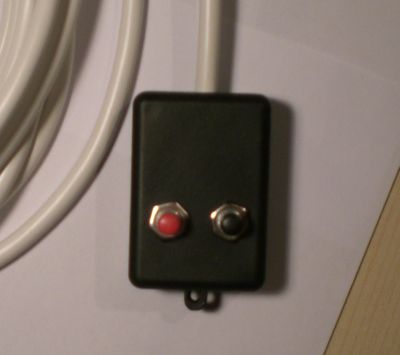
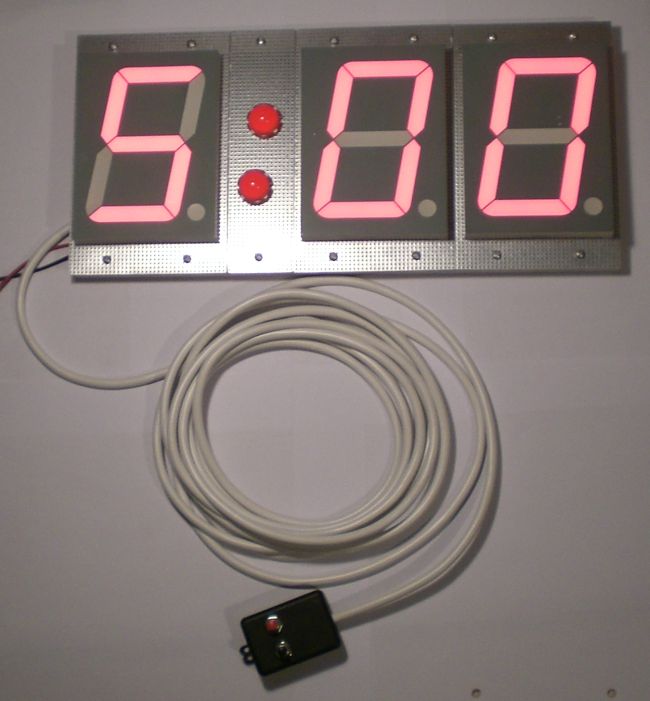
Gesteuert wird der Countdown von zwei Tastern: Der eine Taster (SW1) dient zum Starten/Stoppen des Countdowns (immer abwechselnd), der andere Taster (SW2) zum Resetten auf die eingestellte Startzeit.

Der Schaltplan wirkt natürlich sehr komplex und ohne geätzte Platine nur schwer aufzubauen. Dennoch ist es eigentlich gar nicht so kompliziert, da alles weitestgehend parallel aufgebaut wird.

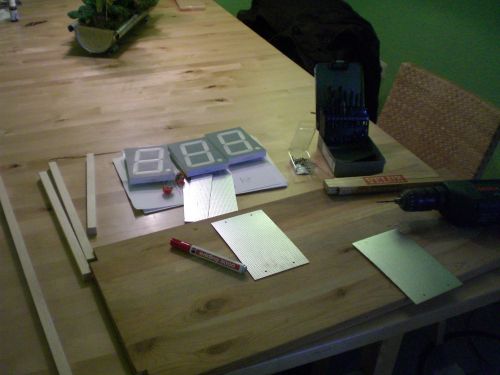
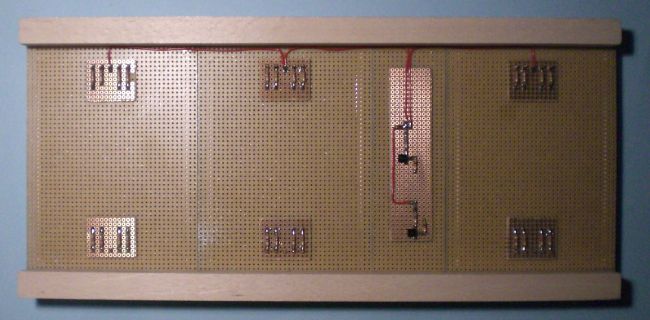
Die drei Anzeigen wurden auf je einer Europaplatine (160mmx100mm) untergebracht, die Doppelpunkte bekamen eine ca. 4cm breite Extraplatine spendiert. Die Trägerplatinen selber besaßen kein Kupfer-Lochraster, sodass auf der Rückseite dieser Platinen ein paar Hilfsplatinen mit Kupferraster angeklebt werden mussten. Die vier Platinen wurden zunächst silber besprüht und dann auf je einer Dachlatte pro Seite verschraubt:

Der Arbeitsplatz

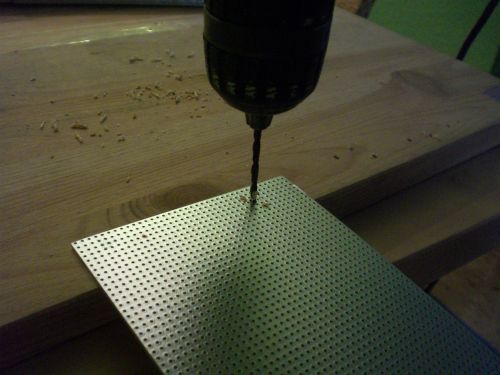
Das Bohren der Platinen

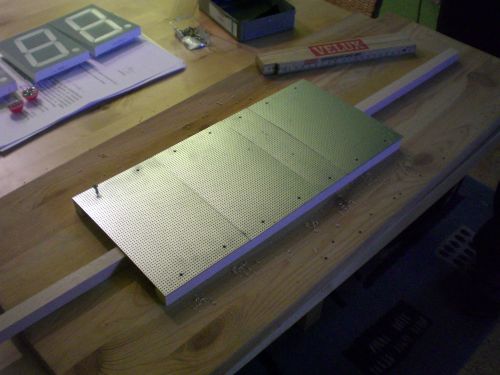
Das komplette Modul wird gebohrt

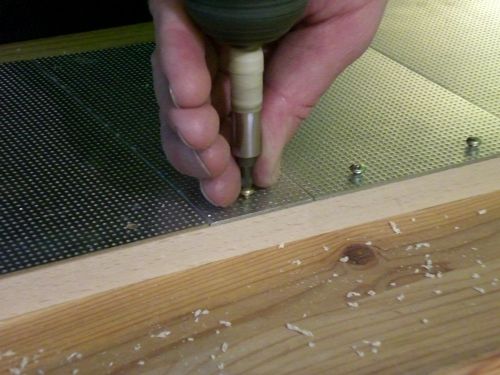
Das Verschrauben der Platinen

Hier sieht man das Modul von der Rückseite:

Das Modul von der Rückseite

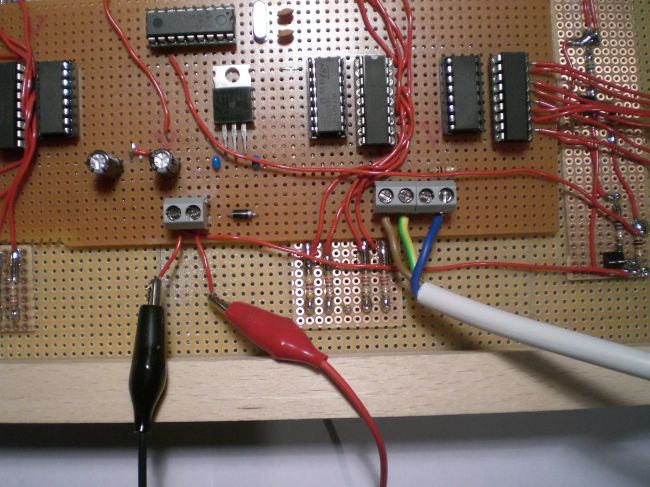
Die angeklebten Platinen sind gut zu erkennen. Die Vorwiderstände wurden direkt an die Pins der ANzeigen gelötet, um Platz auf der Steuerungsplatine einzusparen. SO auch die beiden Treibertransistoren für die Doppelpunkte.

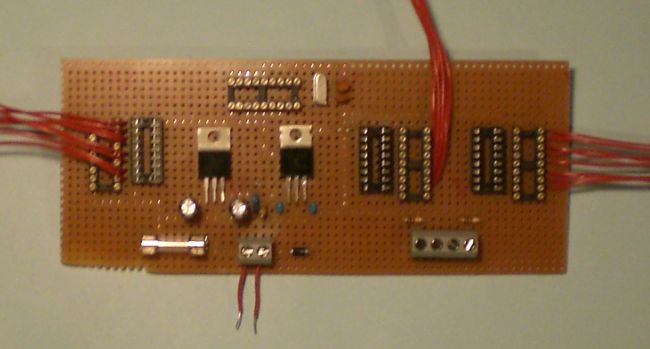
Hier ist das Steuerungsmodul zu sehen:

Die Steuerungsplatine

Es fallen die beiden transistor-ähnlichen Bauteile in der Mitte auf. Das sind beides Spannungsregler; der rechte Spannungsregler ist der des Typs 7805, der auch im obigen Schaltplan zu sehen ist. Der zweite, linke SPannungsregler ist ein 7812-Regler (für 12V also), der aber später entfernt wurde, da 12V als Eingansspannung dienen sollten.

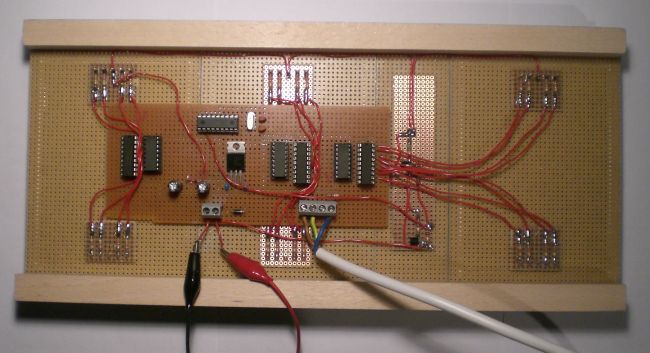
Die langen roten Drähte weg von der Platine sind die Steuerungsleitungen weg von den ULN2804A-Treibern, die direkt zu den Segmenten führen. Diese dienen festgelötet dann auch als Befestigung für die Steuerungsplatine am gesamten Modul.

Hier ist das fertige Modul von hinten zu sehen:

Modul von hinten

Die vierpolige Klemmleiste unten rechts ist die Anschlussbuchse für das Steuerungsmodul:

Das Steuerungsmodul

Hier sieht man die Anschlüsse an der Steuerungsplatine noch mal genau:

Die Anschlüsse an der Steuerungsplatine

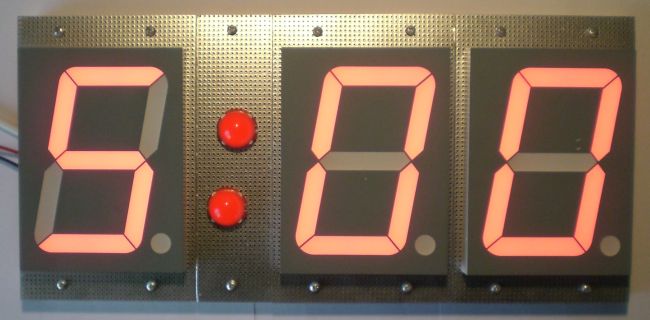
Und so sieht die Schaltung fertig und im Betrieb aus (die Startzeit ist innerhalb der Software auf 5 Minuten (300s) eingestellt, das sollte nach Durchsicht des Programmcodes aber leicht abzuändern sein):

Die Schaltung im Betrieb

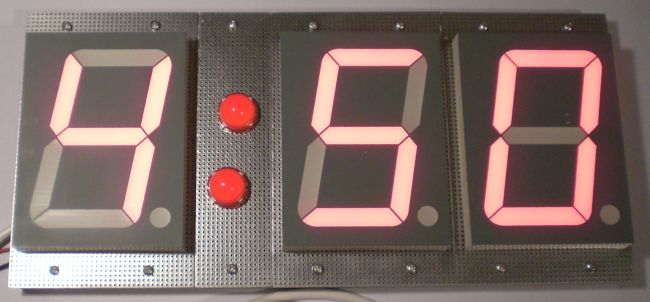
Und nach vergangener Zeit:

Die Schaltung im Betrieb nach vergangener Zeit


Das gesamte Modulcountdown.zip (3KB)این هم فایل zip


خروجی رو  همین الان ببینین بعد بسازید 

 T = 0,695 (Ra + 2Rb) C1 بااین فرمول زمان رو میتونید تغییر بدید


Belli bir sırada yanan ışıkların devre şeması için parça listesi
Vcc +5V doğru gerilim
Ra 2.2 kW 1/4 watt direnç
Rb 4.3 kW 1/4 wattdirenç
C1 100 µF 25V elektrolitik kapasitör
U1 LM555 zamanlayıcısı
U2 74LS74 çiftli D-tipi flip-flop
U3 74LS138 3-giriş 8-çıkışlı decoder
Rx 330 W 1/4 watt direnç
LED1-8 Genel amaçlı ışık veren diyot (LED)

 
.


مدهر منبع تغذیه متغیر

 
Şekil 1: Sabit bir geriliim regülatörü kullanarak ayarlanabilir
doğru gerilim güç kaynağı oluşturulması.

Sabit gerilim regülatörü kullanarak ayarlanabilir güç kaynağı için parça listesi
V1 +18V doğru gerilim (regüle edilmemiş)
R1 500 W 1/4 watt direnç
R2 1 kW 1/4 watt ayarlı direnç
C1 1 µF seramik kapasitör
C2 0.1 µF seramik kapasitör
U1 7805 +5V sabit pozitif gerilim regülatörü

معرفی انواع سیگنال وخصوصیاتوسایر اطلاعات جالب دررابطه با سیگنالهای رایج


.
Introducing signals

In electronic circuits things happen. Voltage/time, V/t, graphs provide a useful method of describing the changes which take place.

The diagram below shows the V/t graph which represents a DC signal:

V/t graph for a DC signal

This is a horizontal line a constant distance above the X-axis. In many circuits, fixed DC levels are maintained along power supply rails, or as reference levels with which other signals can be compared.

Compare this graph with the V/t graphs for several types of alternating, or AC, signals:

alternating signals

As you can see, the voltage levels change with time and alternate between positive values (above the X-axis) and negative values (below the X-axis). Signals with repeated shapes are called waveforms and include sine waves, square waves, triangular waves and sawtooth waves. A distinguishing feature of alternating waves is that equal areas are enclosed above and below the X-axis.

beginning of chapter Up


.
Sine waves

A sine wave has the same shape as the graph of the sine function used in trigonometry. Sine waves are produced by rotating electrical machines such as dynamos and power station turbines and electrical energy is transmitted to the consumer in this form. In electronics, sine waves are among the most useful of all signals in testing circuits and analysing system performance.

Look at the sine wave in more detail:

sine wave

The terms defined below are needed to describe sine waves and other waveforms precisely:

1. Period: T : The period is the time taken for one complete cycle of a repeating waveform. The period is often thought of as the time interval between peaks, but can be measured between any two corresponding points in successive cycles.

2. Frequency: f : This is the number of cycles completed per second. The measurement unit for frequency is the hertz, Hz. 1 Hz = 1 cycle per second. If you know the period, the frequency of the signal can be calculated from:

Conversely, the period is given by:

Signals you are likely to use vary in frequency from about 0.1 Hz, through values in kilohertz, kHz (thousands of cycles per second) to values in megahertz, MHz (millions of cycles per second).

3. Amplitude: In electronics, the amplitude, or height, of a sine wave is measured in three different ways. The peak amplitude, Vp , is measured from the X-axis, 0 V, to the top of a peak, or to the bottom of a trough. (In physics 'amplitude' usually refers to peak amplitude.) The peak-to-peak amplitude, Vpp , is measured between the maximum positive and negative values. In practical terms, this is often the easier measurement to make. Its value is exactly twice Vp .

Although peak and peak-to-peak values are easily determined, it is often more useful to know the root mean square, or rms amplitude of the wave, where:

or

and:

or

What is rms amplitude and why is it important?

KEY POINT: The rms amplitude is the DC voltage which will deliver the same average power as the AC signal.

To understand this, think about two lamps connected to alternative power supplies:

AC and DC compared

The brightness of the lamp illuminated from the AC supply looks constant but the current flowing in the lamp is changing all the time and alternates in direction, flowing first one way and then the other. There is no current flowing at the instant that the AC signal crosses the X-axis. What you see is the average brightness produced by the AC signal.

The second lamp is illuminated from a DC supply and its brightness really is constant because the current flowing is always the same. It is obviously possible to adjust the voltage of the DC supply until the two lamps are equally bright. When this happens, the DC supply is providing the same average power as the AC supply. At this point, the DC voltage is equal to the Vrms value for the AC signal.

A bit of mathematics is needed to explain why the equivalent DC value is called the root mean square value. If you want to know about this click here. What is important at this stage is to remember that the AC signal and its rms equivalent provide the same average power.

4. Phase: It is sometimes useful to divide a sine wave into degrees, ° , as follows:

phase

Remember that sine waves are generated by rotating electrical machines. A complete 360° turn of the voltage generator corresponds to one cycle of the sine wave. Therefore 180° corresponds to a half turn, 90° to a quarter turn and so on. Using this method, any point on the sine wave graph can be identified by a particular number of degrees through the cycle.

If two sine waves have the same frequency and occur at the same time, they are said to be in phase:

in phase and out of phase

On the other hand, if the two waves occur at different times, they are said to be out of phase. When this happens, the difference in phase can be measured in degrees, and is called the phase angle, . As you can see, the two waves in part B are a quarter cycle out of phase, so the phase angle = 90°.

beginning of chapter Up Go to Checkpoint

.
Listening to waves

It can be helpful in understanding what is meant by 'frequency' and 'amplitude' to compare the sounds produced when different waves are played through a loudspeaker.

Not all frequencies are audible. The hi-fi range is defined as from 20 Hz to 20 kHz, approximately the same as the range of frequencies which can normally be detected. As you get older, you will find it more and more difficult to hear higher frequencies. Experience suggests that, by the time you are able to afford a decent hi-fi system, you will probably be unable to fully appreciate its performance.

ALTERNATIVE
     NAMES
The pitch of a musical note is the same as its frequency
The intensity or loudness of a musical note is the same as its amplitude

Your ears are particularly sensitive to sounds in the middle range, from about 500 Hz to 2 kHz, corresponding with the range of frequencies found in human speech. Telephone systems have a poor high frequency performance but do work effectively in this middle range.

When you design an alarm system with an audible output, it is important to keep the frequency of the alarm sounds within this middle range.

The graphs below show waveforms of different frequency and amplitude. Click on the button below each graph to listen to the corresponding sounds:

   Play sound    Play sound
   Play sound    Play sound
   Play sound    Play sound

These sine wave signals produce a 'pure' sounding tone. If the amplitude is increased, the sound is louder. If the frequency is increased, the pitch of the sound is higher.

Other shapes of signal generate sounds with the same fundamental pitch, but can sound different. Compare the sine wave sounds with square signals at 500 Hz and 1 kHz:

   Play sound    Play sound

The square wave sound is harsher because the signal contains additional frequencies which are multiples of the fundamental frequency. These additional frequencies are called harmonics. Sounds from different musical instruments are distinguished by their harmonic content.

beginning of chapter Up


.
Making waves

Sine waves can be mixed with DC signals, or with other sine waves to produce new waveforms. Here is one example of a complex waveform:

complex waveform

'Complex' doesn't mean difficult to understand. A waveform like this can be thought of as consisting of a DC component with a superimosed AC component. It is quite easy to separate these two components using a capacitor, as will be explained in Chapter 5.

More dramatic results are obtained by mixing a sine wave of a particular frequency with exact multiples of the same frequency, in other words, by adding harmonics to the fundamental frequency. The V/t graphs below show what happens when a sine wave is mixed with its 3rd harmonic (3 times the fundamental frequency) at reduced amplitude, and subsequently with its 5th, 7th and 9th harmonics:

constructing a square wave

As you can see, as more odd harmonics are added, the waveform begins to look more and more like a square wave.

This surprising result illustrates a general principle first formulated by the French mathematician Joseph Fourier, namely that any complex waveform can be built up from a pure sine waves plus particular harmonics of the fundamental frequency. Square waves, triangular waves and sawtooth waves can all be produced in this way.

beginning of chapter Up Go to Checkpoint

.
Other signals

This part of the Chapter outlines the other types of signal you are going to meet. Circuits which generate these signals are versatile building blocks and many practical examples are given later in Design Electronics.

1. Square waves: Like sine waves, square waves are described in terms of period, frequency and amplitude:

square waves and rise time

Peak amplitude, Vp , and peak-to-peak amplitude, Vpp , are measured as you might expect. However, the rms amplitude, Vrms , is greater than that of a sine wave. Remember that the rms amplitude is the DC voltage which will deliver the same power as the signal. If a square wave supply is connected across a lamp, the current flows first one way and then the other. The current switches direction but its magnitude remains the same. In other words, the square wave delivers its maximum power throughout the cycle so that Vrms is equal to Vp . (If this is confusing, don't worry, the rms amplitude of a square wave is not something you need to think about very often.)

Although a square wave may change very rapidly from its minimum to maximum voltage, this change cannot be instaneous. The rise time of the signal is defined as the time taken for the voltage to change from 10% to 90% of its maximum value. Rise times are usually very short, with durations measured in nanoseconds (1 ns = 10-9 s), or microseconds (1 µs = 10-6 s), as indicated in the graph.

2. Pulse waveforms: Pulse waveforms look similar to square waves, excpet that all the action takes place above the X-axis. At the beginning of a pulse, the voltage changes suddenly from a LOW level, close to the X-axis, to a HIGH level, usually close to the power supply voltage:

pulse waveform

Sometimes, the 'frequency' of a pulse waveform is referred to as its repetition rate. As you would expect, this means the number of cycles per second, measured in hertz, Hz.

The HIGH time of the pulse waveform is called the mark, while the LOW time is called the space. The mark and space do not need to be of equal duration. The mark space ratio is given by:

A mark space ratio = 1.0 means that the HIGH and LOW times are equal, while a mark space ratio = 0.5 indicates that the HIGH time is half as long as the LOW time:

mark space ratio

A mark space ratio of 3.0 corresponds to a longer HIGH time, in this case, three times as long as the space.

Another way of describing the same types of waveform uses the duty cycle, where:

When the duty cycle is less than 50%, the HIGH time is shorter than the LOW time, and so on.

A subsystem which produces a continuous series of pulses is called an astable. Chapter ? describes pulse waveforms in more detail and explains how to build a variety of astable circuits. As you will discover, it is useful to be able to change the duration of the pulse to suit particular applications. Other pulse-producing subsystems include monostables, Chapter ?, and bistables, Chapter ?.

3. Ramps: A voltage ramp is a steadily increasing or decreasing voltage, as shown below:

positive and negative ramps

The ramp rate is measured in units of volts per second, V/s. Such changes cannot continue indefinitely, but stop when the voltage reaches a saturation level, usually close to the power supply voltage. Ramp generator circuits are described in Chapter ?.

4. Triangular and sawtooth waves: These waveforms consist of alternate positive-going and negative-going ramps. In a triangular wave, the rate of voltage change is equal during the two parts of each cycle, while in a sawtooth wave, the rates of change are unequal (see graph at the beginning of the Chapter). Sawtooth generator circuits are an essential building block in oscilloscope and television systems.

5. Audio signals: As already mentioned, sound frequencies which can be detected by the human ear vary from a lower limit of around 20 Hz to an upper limit of about 20 kHz. A sound wave amplified and played through a loudspeaker gives a pure audio tone. Audio signals like speech or music consist of many different frequencies. Sometimes it is possible to see a dominant frequency in the V/t graph of a musical signal, but it is clear that other frequencies are present.

audio signal

6. Noise: A noise signal consists of a mixture of frequencies with random amplitudes:

noise

Noise can originate in various ways. For example, heat energy increase the random motion of electrons and results in the generation of thermal noise in all components, although some components are 'noisier' than others. Additional sources of noise include radio signals, which are detected and amplified by many circuits, not just by radio receivers. Interference is caused by the switching of mains appliances, and 'spikes' and 'glitches' are caused by rapid changes in current and voltage elesewhere in an electronic system.

Designers try to eliminate or reduce noise in most circuits, but special noise generators are used in electronic music synthesisers and for other musical effects.

beginning of chapter Up Go to Checkpoint

.
Links

Click on the icon to transfer to the WWW pages:


Heinrich Hertz: brief biography


Joseph Fourier: biography


Demonstrations in auditory perception from McGill University:


Fascinating information on the perception of speech:


beginning of chapter Up Back to Contents